
Hollar's Potter's Wheel™: The 5 Principles of Personal Agency
Sep 15, 2026
TL;DR: Nicole Hollar, behavior change keynote speaker and coach, built Hollar's Potter's Wheel™ so personal agency would stop being an abstract idea and start being something you can actually practice. The framework breaks agency into five repeatable moves: Awareness, Acceptance, Ownership, Boundaries, and Choice. This guide walks through what each one means, how they build on each other, and what the framework is deliberately not.
You Didn't Start With a Clean Wheel
Nobody hands you an empty wheel and a fresh lump of clay. You're born already spinning, shaped by family, religion, culture, environment, and every consequence — good and bad — that taught you what happens when you act a certain way. Someone else had a hand on that wheel long before you did.
At some point, the wheel becomes yours. That doesn't mean the shape you were given was wrong, or that you have to hate it to want something different. Sometimes you weren't shaped badly, you just outgrew the shape. A vessel that made sense at twelve doesn't have to make sense at forty.
This is where most people get stuck. They blame the shape on whoever formed it, hand the wheel back to old consequences instead of taking hold of it, or notice that someone else is still trying to keep a hand on it. All three keep you off your own wheel.
Being formed into a bowl doesn't mean you're stuck as a bowl. You can become a mug. That's not about resenting what's familiar, it's about choosing what's fulfilling by design instead of settling for what's familiar by default.
Why a Potter's Wheel
A potter doesn't reshape clay by hating what it already is. She sees what she's working with, keeps it centered, and applies pressure in the right place at the right time knowing what she wants it to become.
The 5 Principles of Personal Agency
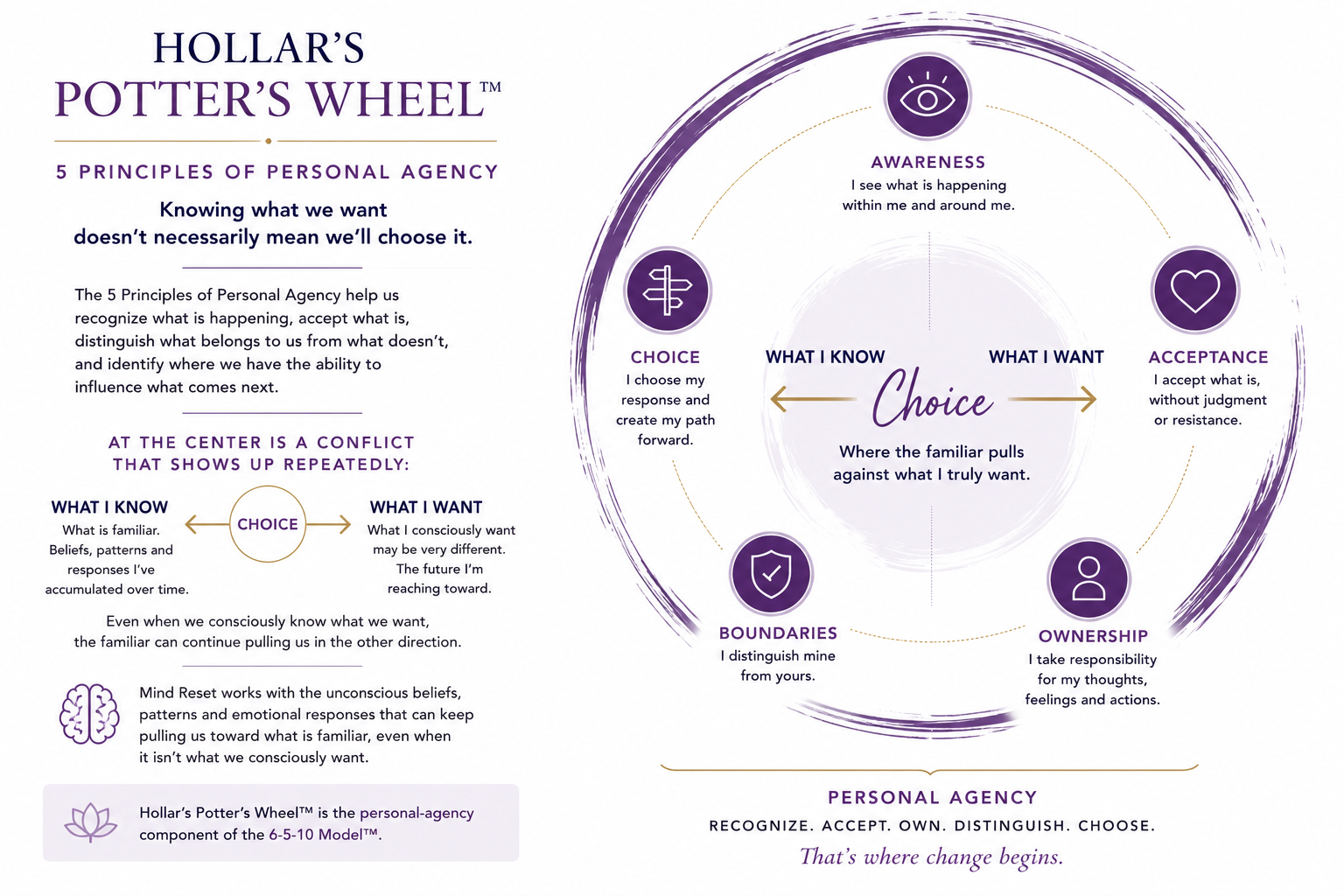
- Awareness — I see it. Before you can change anything, you have to actually see it, not the story you've told yourself about it. Awareness is the difference between “I keep missing deadlines” and “I keep telling myself I work better under pressure so I don't have to start earlier.” One is a fact. The other is a narrative that's been doing a lot of unpaid work for you.
- Acceptance — I acknowledge what it is. This is not the same as liking it, agreeing with it, or being fine with it. Acceptance simply means you stop arguing with something that's already true. You can be furious about a circumstance and still accept that it's the one you're actually standing in.
- Ownership — I recognize my part. Ownership isn't blame, or being responsible for everything. It's identifying the part that's actually yours — your choice, your pattern, your response — separate from what belongs to someone else or to circumstance. You can't fix what you won't claim.
- Boundaries — I distinguish mine from yours. Once you know what's yours, boundaries keep it that way. This is where people give away the most power without noticing — absorbing someone else's mood, deadline panic, or opinion of who you should be.
- Choice — I select what aligns with who I am becoming. This is the pivot: picking the option that matches where you're actually trying to go, not just the one that's familiar. Familiar and right aren't the same thing.
The Wheel Isn't a Straight Line
You don't complete the Wheel once and get a certificate. You can have airtight awareness about your finances and zero boundaries at work, or great ownership with your health and none with a relationship that's been quietly draining you for years. The Wheel keeps turning because life keeps reshaping itself.
What the Wheel Is Not
It's not a blame framework. Ownership isn't “this is all your fault,” and Acceptance isn't “stop complaining.” It's also not a replacement for therapy for trauma, clinical anxiety, or depression.
And it's not a claim that mindset fixes everything — sometimes the issue is resources, information, or bandwidth, not belief. Personal agency means correctly identifying which one you're actually dealing with.
The Point of All of It
My core belief is that power isn't taken; it's given away — a little at a time, without anyone noticing. Hollar's Potter's Wheel™ exists to slow that down long enough for you to notice where you're standing, what's actually yours, who else still has a hand on it, and where you still get to choose.
Questions for Reflection
- Where in your life would an honest look at Awareness reveal a story you've been telling yourself instead of what's actually happening?
- What part of your current shape did someone else make? And are you keeping it on purpose, or just because no one told you the wheel was yours now?
- Where have you been choosing what's familiar and calling it a choice, when it's really just the path of least resistance?
Frequently Asked Questions
What is Hollar's Potter's Wheel™?
Hollar's Potter's Wheel™ is Nicole Hollar's framework for personal agency, built on five principles: Awareness, Acceptance, Ownership, Boundaries, and Choice — a repeatable process for recognizing what's driving your behavior and where you still have power to respond differently.
Is Hollar's Potter's Wheel™ the same as the 6-5-10 Model™?
No. The 6-5-10 Model™ is Nicole's broader whole-person framework for creating change. Hollar's Potter's Wheel™ sits inside that larger body of work as the mechanism for practicing personal agency specifically.
Does changing my shape mean I have to reject where I came from?
No. Wanting a different shape doesn't require resenting the wheel that made you or the people who shaped it early on. Outgrowing a shape is different from disowning it. Keep what serves you, change what no longer fits.